
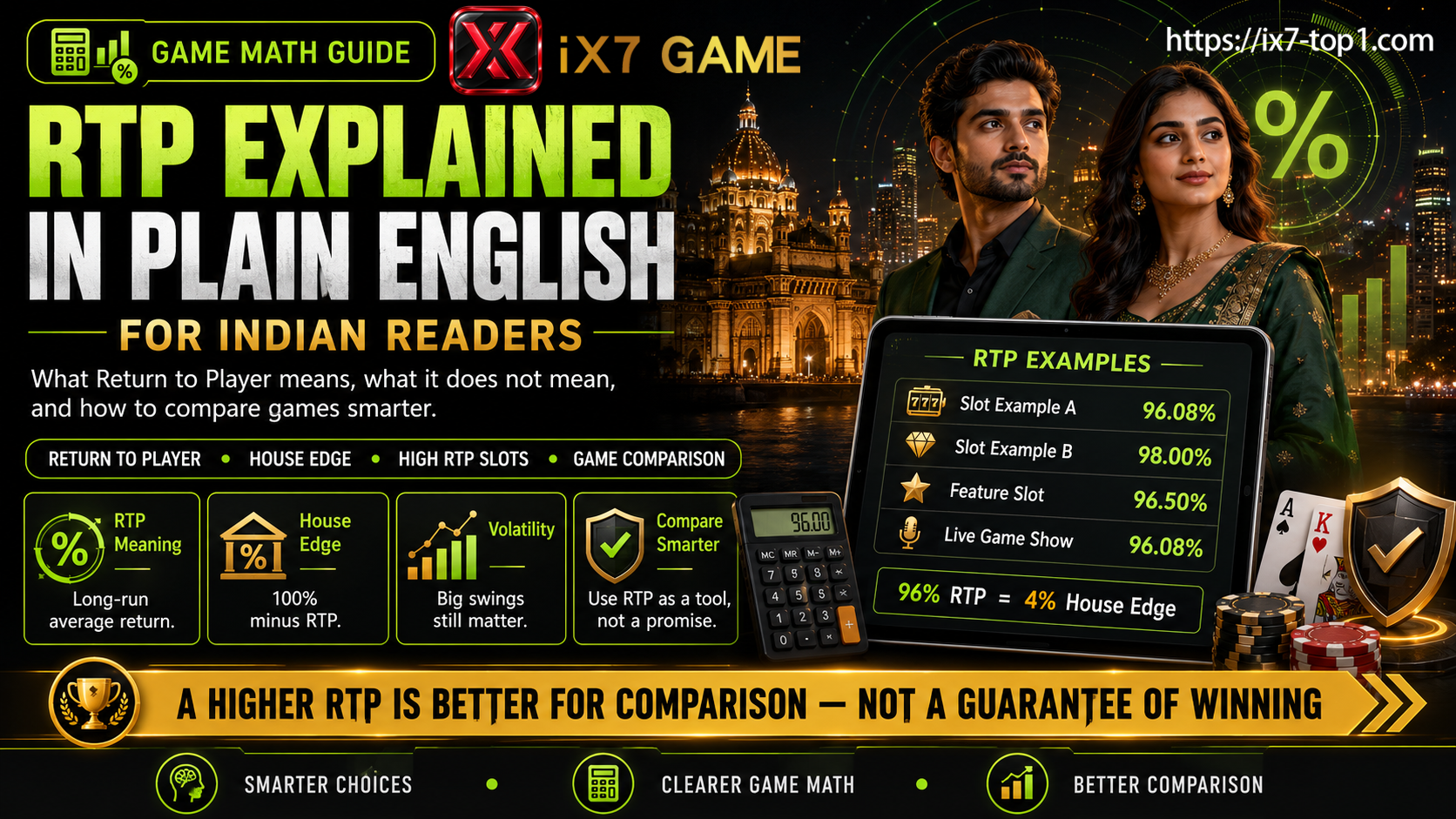
What RTP Tells You — and What It Cannot
Return to Player, or RTP, estimates the share of all stakes a game returns across an enormous number of rounds. That scale matters: the figure helps compare rules, but says little about what one person will see over a few hundred spins.
The Other Side of RTP Is the House Edge
Subtract RTP from 100% to find the theoretical house edge. A slot listed at 96% gives the operator a 4% long-run margin. A higher RTP reduces that margin, but does not make the game predictable, profitable, or low risk.
- At 95% RTP, the theoretical house edge is 5%
- At 96% RTP, the theoretical house edge is 4%
- At 98% RTP, the theoretical house edge is 2%
Why 96% Does Not Mean ₹960 Back from ₹1,000
The percentage does not settle after a neat block of spins. One player may reach a feature immediately while another gets little from the same stake, and both runs can be normal. RTP describes pooled results across far more rounds than an individual is likely to play.
Return and Volatility Answer Different Questions
RTP concerns the amount returned over time; volatility describes the route. Two slots with similar RTP can feel unrelated. One may deliver regular small hits, while another stays quiet before a rare large win. Neither pattern changes the house edge.
Five Details Worth Checking Alongside RTP
- How often any winning combination occurs
- The maximum win and the features used to reach it
- Rules specific to the table or game-show format
- The RTP shown inside the version you are actually opening
- Whether the studio supplies the same title at several RTP settings
The Myths That Refuse to Disappear
A game is not “due” after a cold run, and earlier losses do not improve the next spin. Bonus rounds are already included in the model. A high RTP helps comparison, but cannot promise profit or reveal when to raise a stake.
Use the Number as Context, Not a Strategy
RTP helps Indian readers understand what a game offers. It does not remove randomness, answer local legal questions, or soften a financial loss. Compare the figure, set a firm budget, and remember that not playing is a valid choice.
Quick Questions About RTP
1. What does RTP stand for? Return to Player, a theoretical long-run return across many rounds.
2. Is RTP another name for volatility? No. One measures expected return; the other describes the size and frequency of swings.
3. Does a published RTP promise a win? No. It is not a forecast for an individual account.
4. Can one game have more than one RTP? Yes. Always check the information panel in the version being played.
5. Can RTP be turned into a betting system? No. It helps comparison but cannot predict random results.